The ultimate overview of BCI / Neurotech ecosystem
Global BCI & Neuroscience Landscape
Market Overview
The Big Picture
The global neurotechnology market – spanning brain-computer interfaces, EEG/EMG devices, neurostimulation, neuroimaging, and consumer brain wearables – is valued at approximately $15-17 billion in 2025 and is projected to reach ~$30 billion by 2030 and ~$53 billion by 2034 (CAGR ~13%). What was once a niche academic field has become one of the fastest-growing sectors in deep tech, fueled by breakthroughs in implantable BCIs, the rise of consumer brain wearables, and Big Tech’s race to own the next computing input layer.
Understanding the Main Categories
Before diving into the numbers, here’s what each major segment actually covers and why it matters:
Brain-Computer Interfaces (BCI) are systems that create a direct communication pathway between the brain and an external device. This is the headline-grabbing segment — think Neuralink implants and paralyzed patients controlling cursors with their thoughts. BCIs can be invasive (surgically implanted electrodes that read individual neurons) or non-invasive (external sensors that read aggregate brain activity through the skull). The invasive side is where the most dramatic breakthroughs are happening, but non-invasive BCIs are where the volume market lives.
EEG (Electroencephalography) Devices measure electrical brainwave activity using sensors placed on the scalp — no surgery required. This is the oldest and most established category. It spans everything from hospital-grade diagnostic systems (epilepsy monitoring, sleep studies) to consumer headbands that track your focus during meditation. The big shift here is from bulky clinical machines to portable, wireless wearables — and increasingly, EEG sensors shrinking small enough to fit inside earbuds.
EMG (Electromyography) Devices read the electrical signals your muscles produce when they contract. Surface EMG (sEMG) — measured from the skin without needles — is the variety driving most of the growth. The applications range from clinical diagnostics and rehabilitation to prosthetic hand control and, most excitingly, gesture-control wristbands that let you interact with computers through subtle finger movements. Meta’s Neural Band is the highest-profile example: an EMG wristband that serves as the input device for AR glasses.
Neurostimulation is the largest segment by revenue, and it works in the opposite direction from the others — instead of reading neural signals, it writes to the nervous system by delivering targeted electrical or magnetic pulses. Deep brain stimulation (DBS) for Parkinson’s and epilepsy, transcranial magnetic stimulation (TMS) for depression, and transcranial direct current stimulation (tDCS) for cognitive enhancement all fall here. This is where most of the current clinical revenue sits because the therapeutic applications are well-established and insurance-reimbursable.
Consumer Brain Wearables is the fastest-evolving category and the hardest to define precisely because it overlaps with EEG and EMG. It encompasses any brain- or neural-sensing device designed for everyday consumers rather than clinical or research use: meditation headbands, brain-sensing headphones that track your focus, sleep-optimizing earbuds, and EMG wristbands for gesture control. This is where the biggest volume opportunity lives — the potential to put neural sensing into devices that hundreds of millions of people already wear daily.
Market Size by Segment
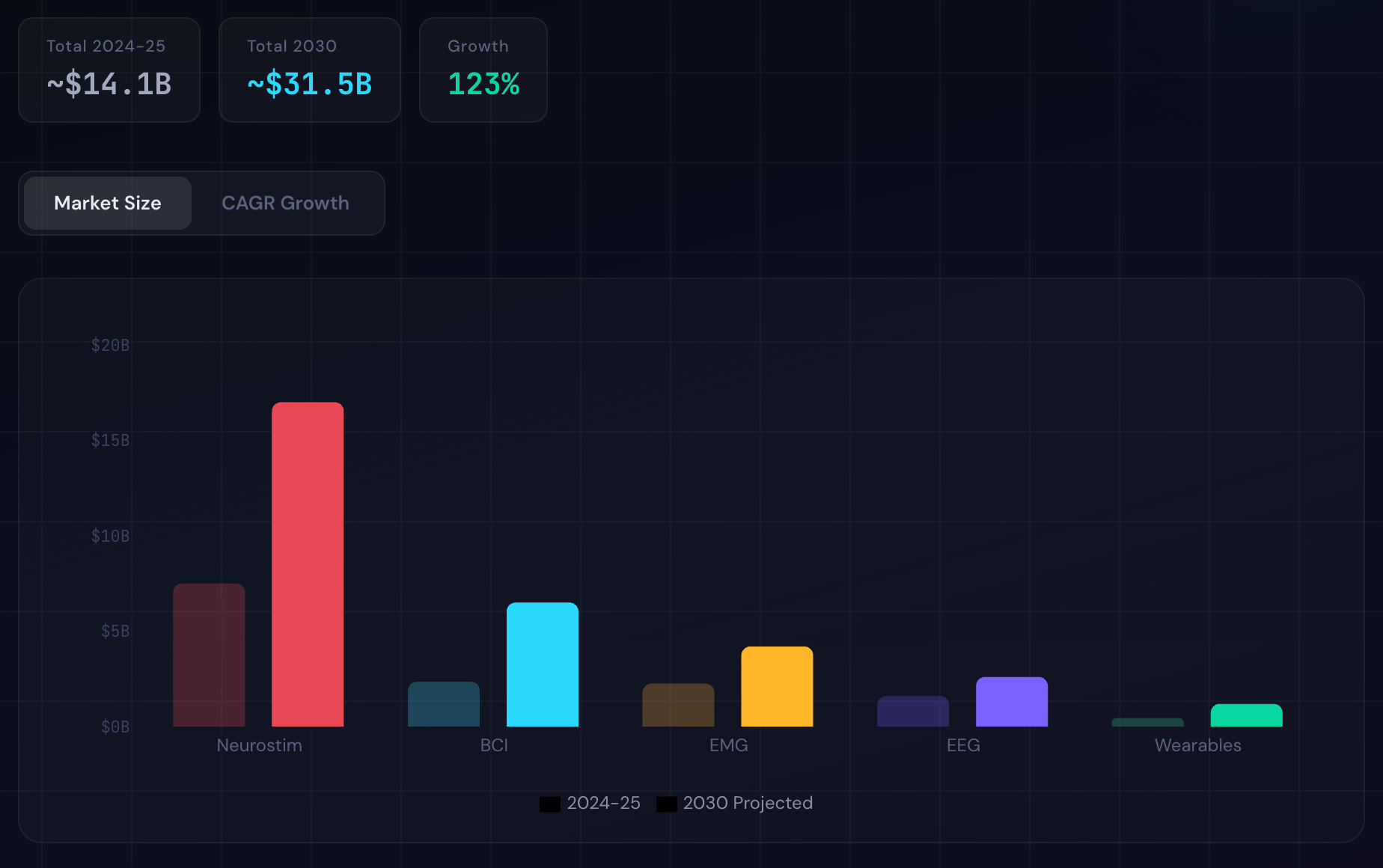
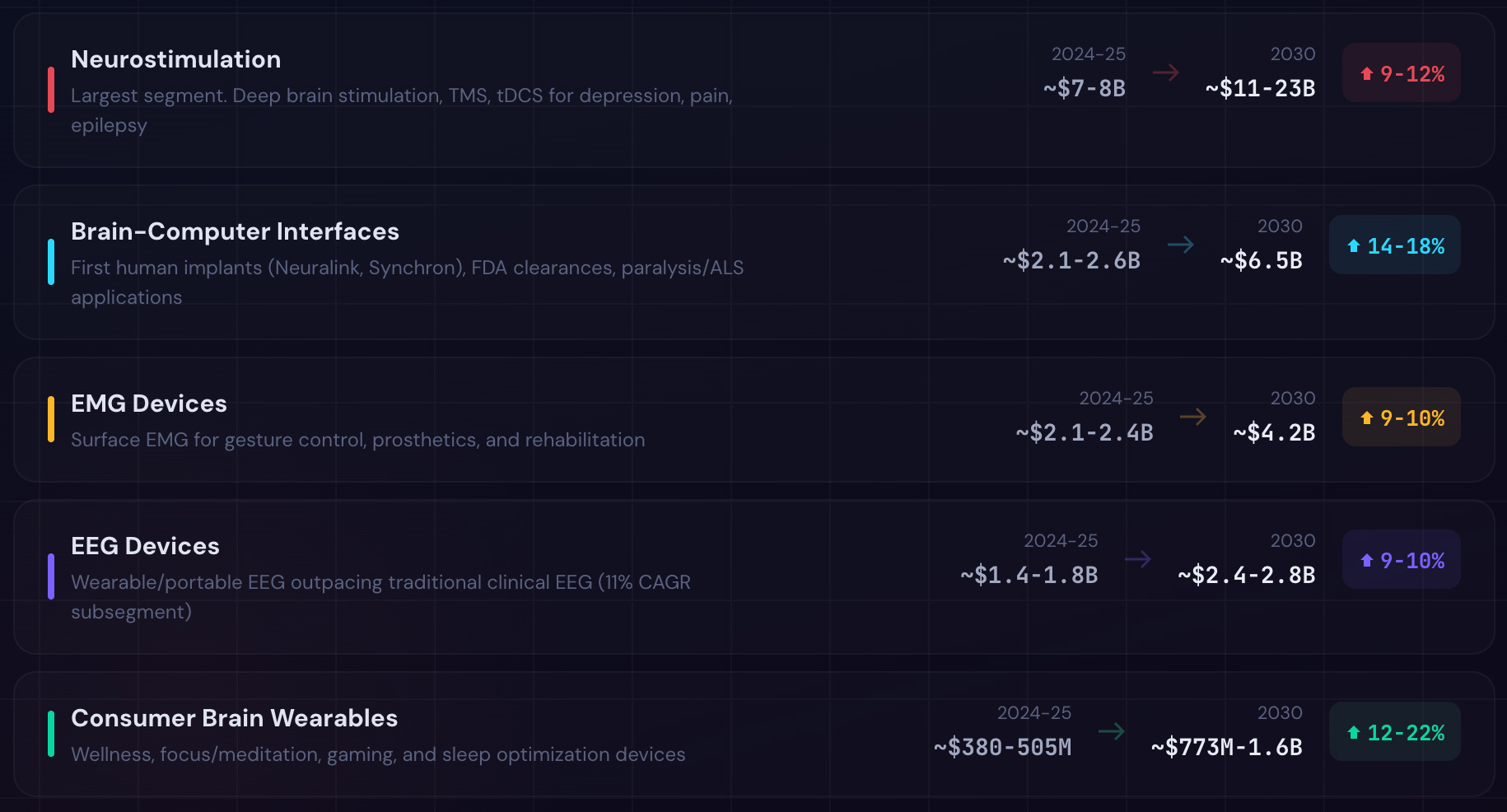
Sources: Grand View Research, Straits Research, MarketsandMarkets, Precedence Research, Mordor Intelligence, Fortune Business Insights
Venture Capital Funding
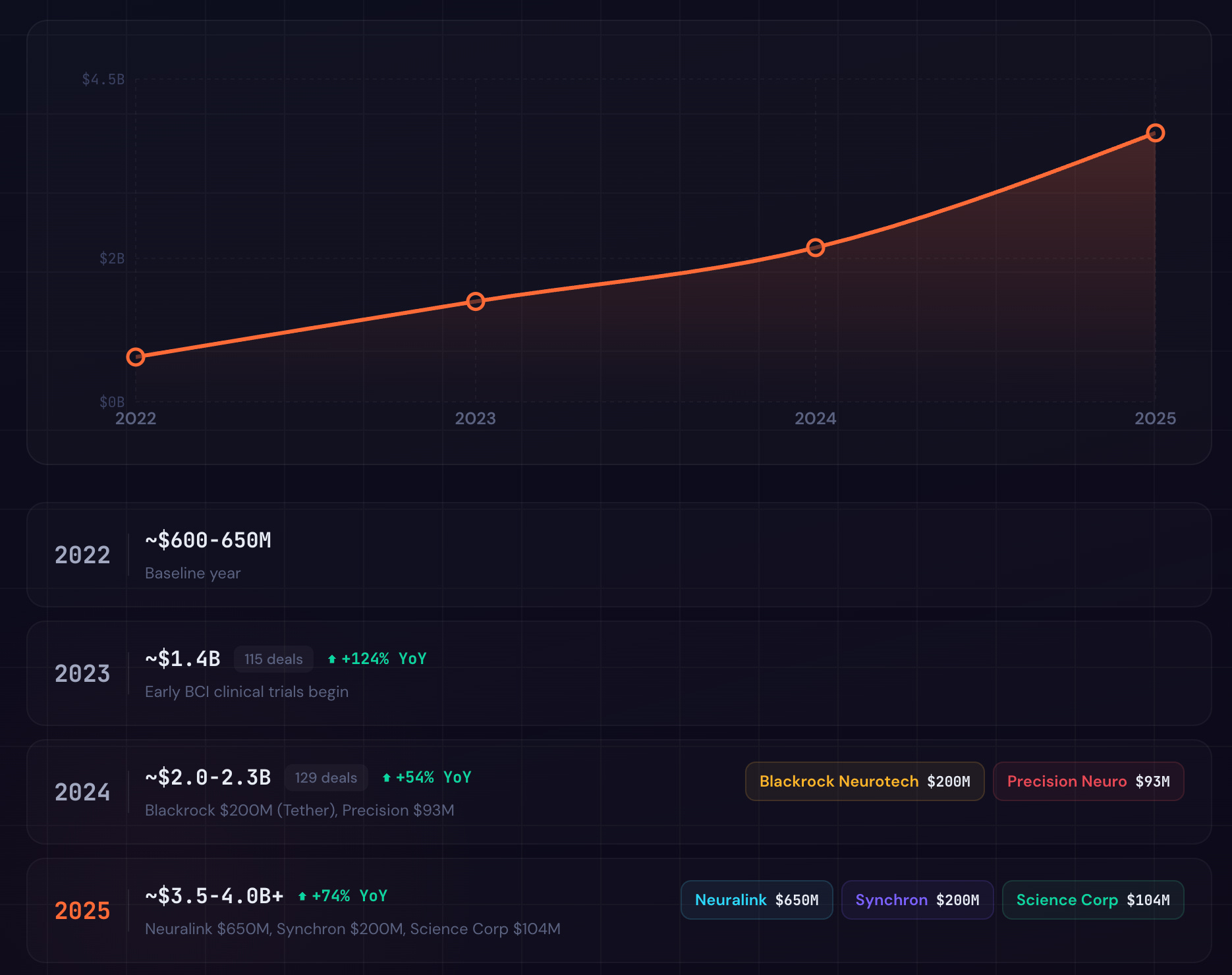
VC funding into neurotech has roughly tripled in two years, making it one of the fastest-growing deep tech investment categories:
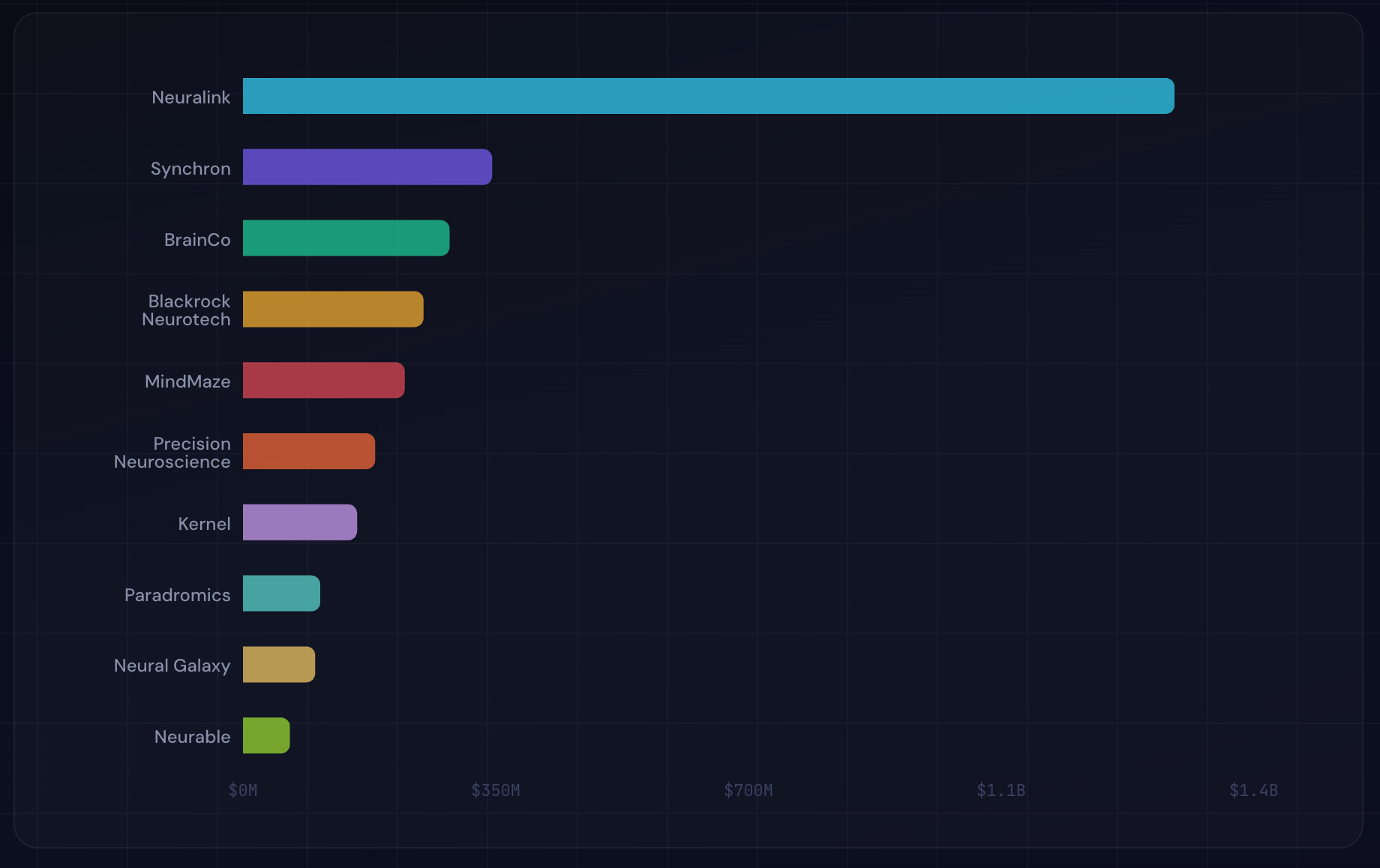
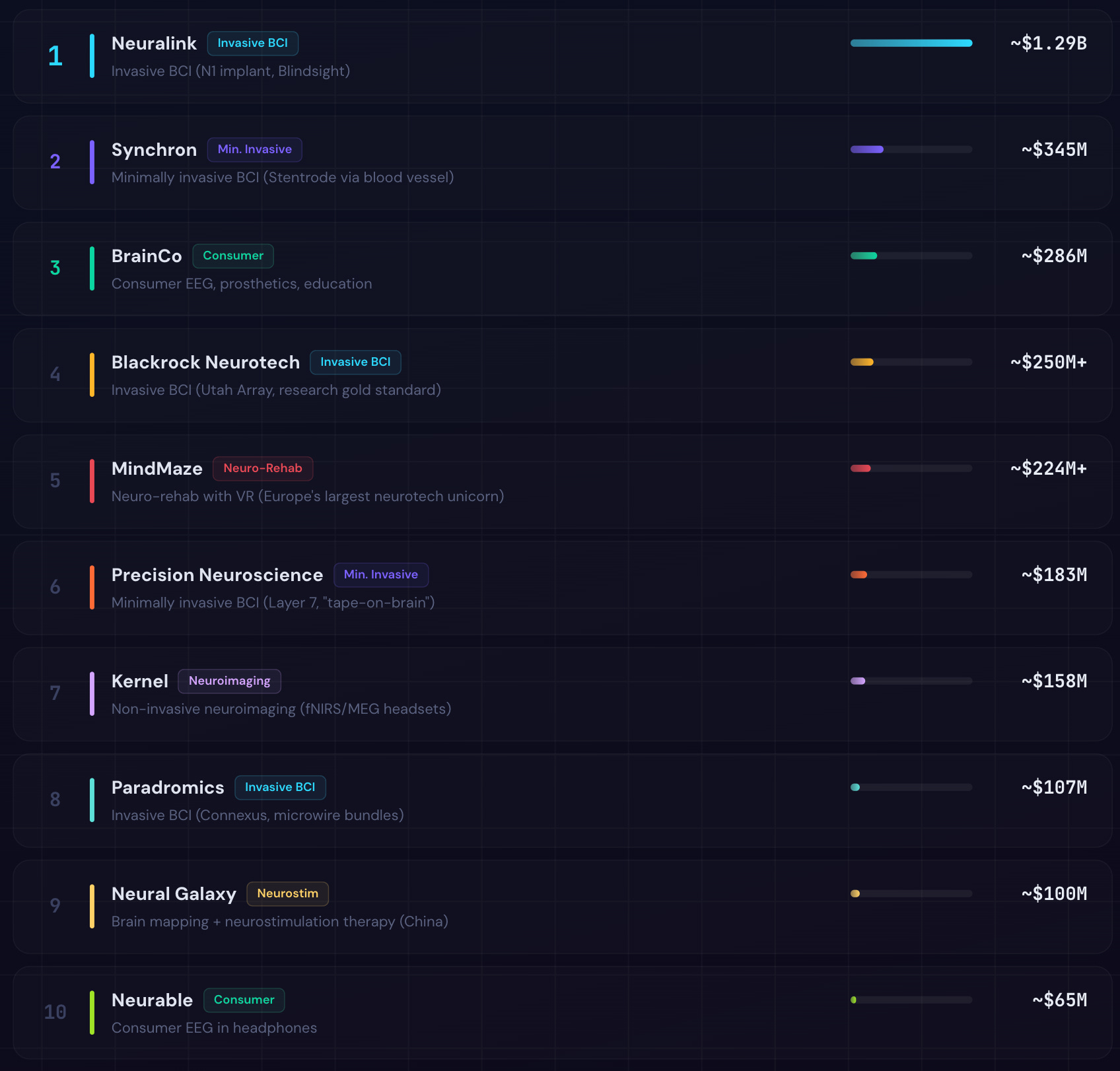
Top 10 Most-Funded Neurotech Companies
Geographic Breakdown
Key Numbers at a Glance
Major Milestones (2024-2026)
2024
Neuralink implants its first human patient (Noland Arbaugh, January 2024)
Blackrock Neurotech receives $200M from Tether
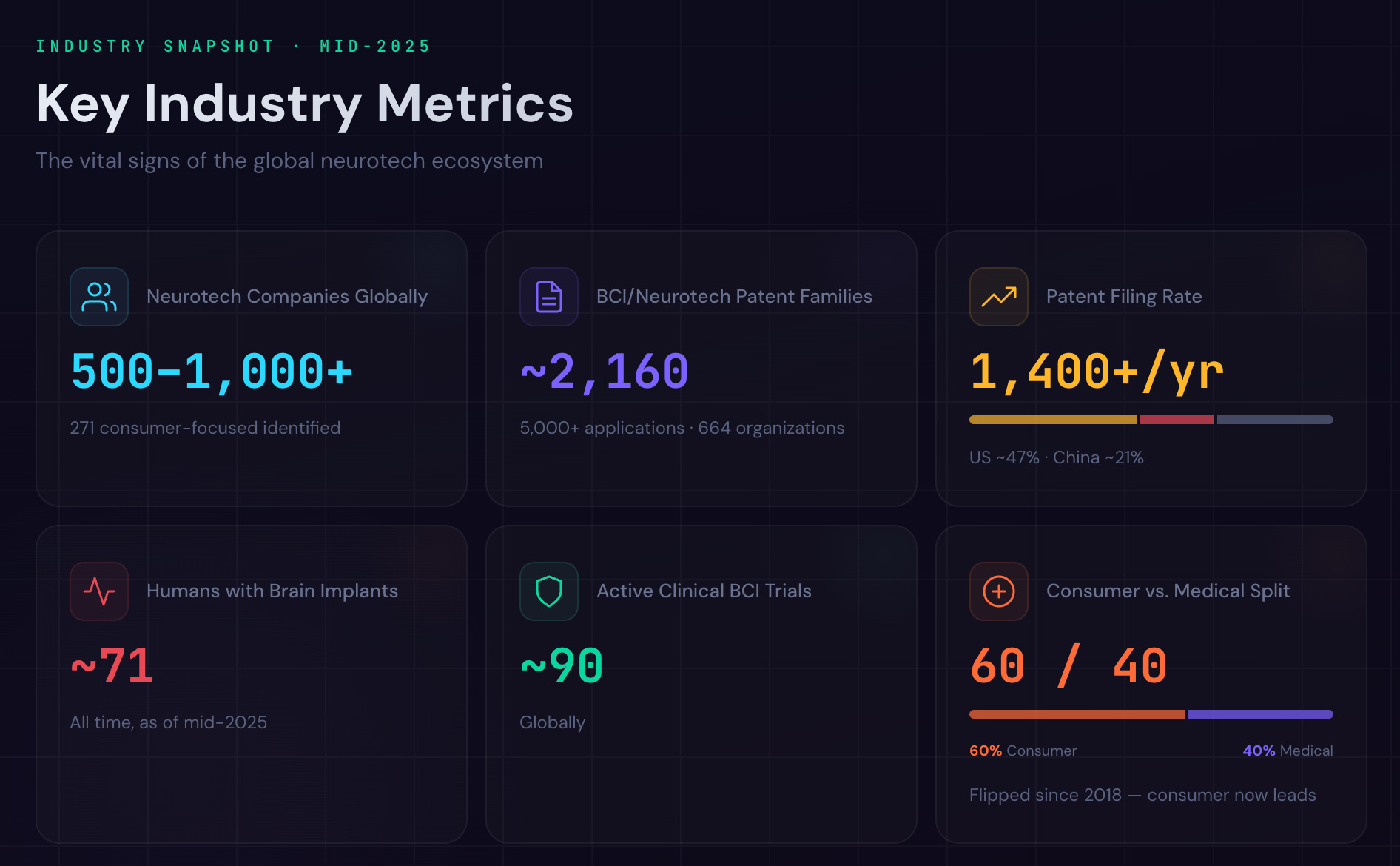
~90 active BCI clinical trials running globally
2025
Neuralink expands to 12 human patients and raises $650M (largest single BCI investment ever)
Neuralink Blindsight (vision restoration) receives FDA Breakthrough Device Designation
Precision Neuroscience receives FDA clearance for core implant component
Paradromics completes first-in-human recording and receives FDA IDE approval
Synchron raises $200M Series D, reaches ~$1B valuation
Brain-sensing earbuds debut at CES 2025; AlterEgo launches silent speech consumer product
Meta Neural Band commercialized with Ray-Ban Display glasses
2026
NextSense (Google X spinoff) ships first consumer EEG earbuds ($399, February 2026)
Apple acquires Q.ai for ~$1.5-2B (silent speech via facial micro-movements)
Neuralink targeting FDA Premarket Approval and high-volume automated implantation
Paradromics expanding clinical trial for speech restoration
Fastest-Growing Segments to Watch
Invasive BCI – 4 companies now in human trials simultaneously (Neuralink, Synchron, Precision, Paradromics). The race is on.
Ear-EEG – Breakout category. NextSense shipping, Apple/Samsung/IDUN building. Brain sensing in earbuds could reach billions of users.
Consumer EEG wearables – Brain-sensing headphones (Neurable), meditation headbands (Muse, BrainCo), and sleep trackers moving from niche to mainstream.
EMG wristbands – Meta’s Neural Band represents the commercial endpoint. Open-source alternatives (3DC, MOT, Upside Down Labs) are building the maker ecosystem.
Silent speech – AlterEgo shipping, Apple invested $1.5-2B. The ability to “talk” to AI without speaking aloud could be as transformative as touchscreens.
Neuroprosthetics – AI-powered prosthetic hands (BrainCo, OYMotion, Myomo) getting smarter and more affordable.
Glossary – Key Terms Explained
Term
What it means
BCI (Brain-Computer Interface)
A system that translates brain activity into commands for a computer or device.
EEG (Electroencephalography)
A method that reads electrical brainwave activity from sensors placed on the scalp – no surgery needed.
EMG (Electromyography)
A method that reads the tiny electrical signals your muscles produce when they contract. Used for gesture control, prosthetics, and rehab.
sEMG (Surface EMG)
EMG measured from the skin surface (no needles), using adhesive or dry electrodes.
fNIRS (Functional Near-Infrared Spectroscopy)
Uses light (near-infrared) shone through the skull to measure blood flow changes in the brain – a proxy for brain activity. Non-invasive.
MEG (Magnetoencephalography)
Measures the tiny magnetic fields produced by brain activity. Very precise timing but traditionally requires a room-sized machine.
tDCS / tACS / tRNS
Types of non-invasive brain stimulation. They send weak electrical currents through the scalp to boost or calm brain activity. Used for depression, focus, pain, and rehab.
Neurofeedback
A training technique where you see (or hear) your brain activity in real-time and learn to consciously shift it – like a mirror for your brain. Used for ADHD, anxiety, and peak performance.
Channel count (e.g. “8-ch”, “256-ch”)
The number of independent sensors recording simultaneously. More channels = more detailed picture of brain/muscle activity.
Dry electrode
A sensor that works on bare skin without conductive gel or paste. Faster to set up, more comfortable, but traditionally noisier.
Active electrode
An electrode with a tiny amplifier built in at the sensor site, which boosts the signal before it travels down the wire. Dramatically reduces noise and setup time.
IMU (Inertial Measurement Unit)
A motion sensor combining accelerometer + gyroscope (+ sometimes magnetometer). Tracks orientation and movement.
FDA cleared / FDA 510(k)
The US Food & Drug Administration has reviewed the device and determined it is safe and effective for its intended medical use.
CE-marked
Meets European Union health, safety, and environmental standards for medical devices.
Open-source
The designs, code, and documentation are publicly available for anyone to study, modify, and build upon.
ADS1299
A popular Texas Instruments chip purpose-built for reading biopotential signals (EEG/EMG/ECG). The go-to IC for many open-source neurotech projects.
Silent speech interface
A device that reads the tiny electrical signals your brain sends to your speech muscles when you “think” words without speaking aloud (subvocalization), then decodes those signals into text or commands. No sound leaves your mouth.
Ear-EEG
EEG electrodes miniaturized to fit inside or around an earbud, reading brain signals from the ear canal. Less spatial coverage than a full head cap, but vastly more wearable for everyday use.
Bone conduction
A way to deliver sound by vibrating your skull bones directly, bypassing the eardrum. You hear audio privately without blocking outside sounds. Used in some silent speech devices for discreet feedback.
PPG (Photoplethysmography)
Uses light (usually green or infrared) shone into the skin to measure blood flow changes. This is how smartwatches and AirPods track your heart rate.
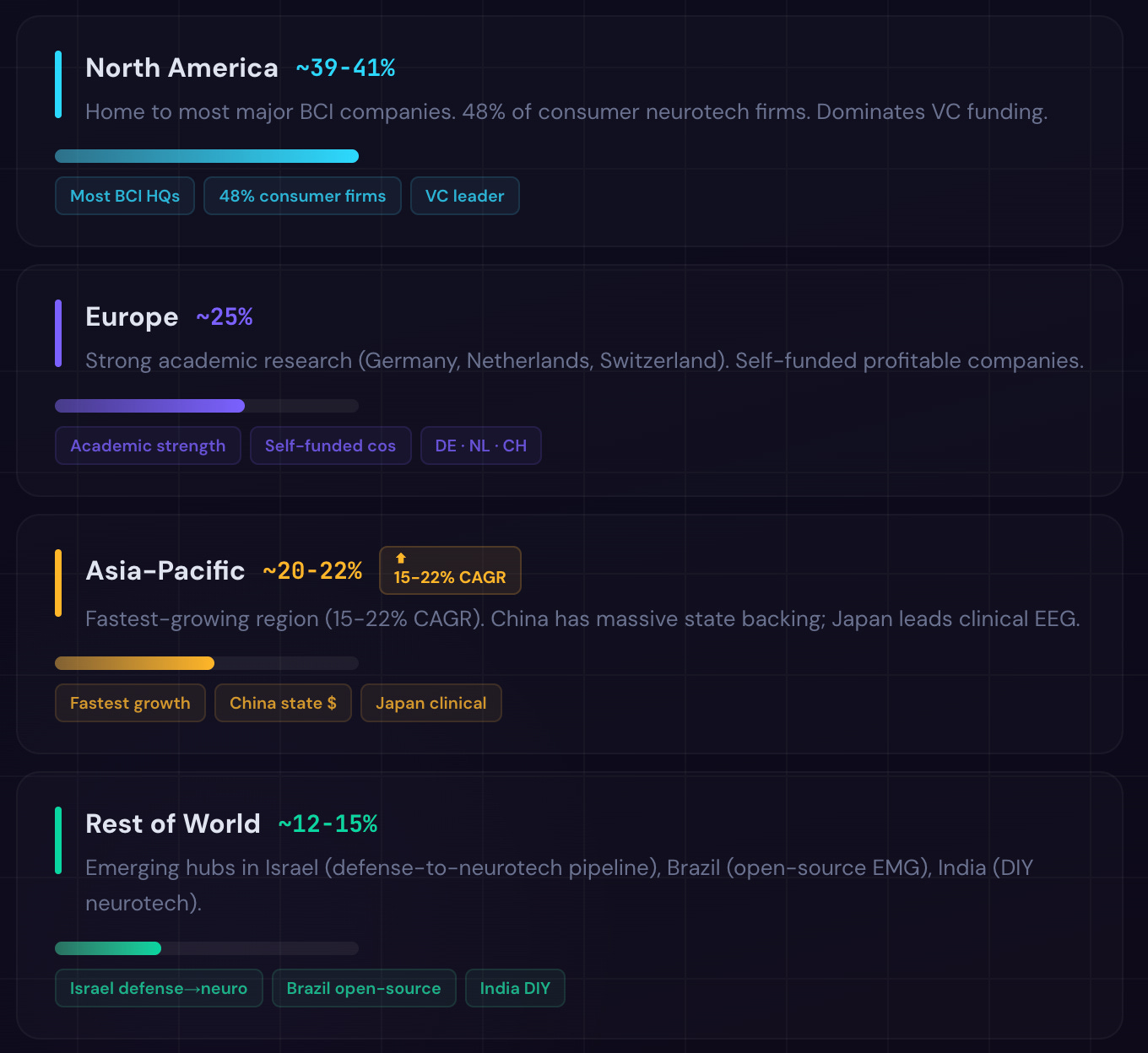
United States (~120 BCI companies, $2.55B invested)
Invasive BCI
Neuralink – Elon Musk’s moonshot that placed the first commercial-grade 1,024-electrode implant in a human brain, catalyzing the entire industry’s race to market. Funding: ~$1.29B raised (Series E at $9.7B valuation). Founders Fund, Sequoia, GV, ARK Invest. Products include the N1 Implant (a coin-sized wireless chip surgically placed in the brain with 1,024 tiny electrodes), R1 Robot (a precision surgical robot for electrode thread insertion), and N1 App (companion software for real-time brain signal decoding).
Blackrock Neurotech – The longest-running human BCI company, whose Utah Array has been implanted in more human brains than any other intracortical device. Funding: ~$250M+ ($49.7M VC + $200M from Tether). Products include the Utah Array (100-electrode silicon grid, the gold standard for brain research), NeuroPort BCI System, and MoveAgain BCI for at-home use by paralysis patients.
Paradromics – Completed its first human implant in mid-2025 with a novel “microwire bundle” architecture. Funding: ~$107M. Products: Connexus BCI, a fully implantable system using bundles of hair-thin microwires recording from up to 1,684 brain cells simultaneously.
Precision Neuroscience – Co-founded by a Neuralink co-founder, building a minimally invasive, safely removable BCI. Funding: ~$183M. Products: Layer 7 Cortical Interface, an ultra-thin flexible film (1/5th the thickness of a human hair) with 1,024 electrodes that sits on the brain’s surface.
Synchron – First BCI company to receive FDA IDE approval for a permanent implant trial in the US, implanted via catheter through the jugular vein. Funding: ~$345M (backed by Jeff Bezos, Bill Gates). Products: Stentrode, a mesh-like stent with electrodes delivered to the brain through a blood vessel. Already integrated with Apple’s Switch Control.
Axoft – Harvard/MIT spinout building implants from materials ~10,000x softer than conventional electrodes. Funding: ~$18.9M. Products: Fleuron Intracortical Probes, 128-electrode arrays made from a gold-polymer composite engineered to be as soft as brain tissue.
EEG / Non-Invasive
Emotiv (SF, founded in Sydney) – Pioneered accessible EEG for non-neuroscientists, with headsets used by 100,000+ researchers in 140+ countries. Funding: ~$10M. Products: EPOC X (14-sensor), EPOC Flex (32-sensor), Insight (5-sensor lightweight), and EmotivPRO/EmotivBCI software platforms.
Neurable (Boston) – Proved consumer BCI can ship at scale by embedding EEG sensors into premium headphones. Funding: ~$65M. Products: MW75 Neuro luxury headphones with hidden EEG sensors, HyperX Gaming Headset, and the Neurable AI Platform.
Kernel (LA) – Founded by Bryan Johnson ($100M personal seed), built advanced non-invasive neuroimaging headsets. Funding: ~$158M. Products: Kernel Flow (fNIRS wearable helmet), Kernel Flux (MEG headset), Sound ID, and Neuroscience-as-a-Service (NaaS).
NeuroSky (San Jose) – One of the earliest companies to bring brainwave-sensing to the mass market, shipping millions of biosensor chips. Funding: ~$27.9M. Products: MindWave Mobile, ThinkGear ASIC Module (TGAM), and BMD200 Bluetooth module.
Advanced Brain Monitoring (Carlsbad, CA) – A 25+ year veteran in ambulatory EEG with one of the largest normative brain databases (10,000+ sessions). Funding: $34M+ in grants. Products: B-Alert X-Series wireless EEG headsets, Sleep Profiler (FDA-cleared home sleep testing), and BEAM Platform for early Alzheimer’s detection.
Electrical Geodesics / EGI – Pioneered 256+ electrode EEG nets, the de facto standard in cognitive neuroscience research. Acquired by Philips (~$37M, 2017), then Magstim (2020). Products: Geodesic EEG System, Hydrocel Sensor Net, Net Station, and GES for MRI.
NeuroScan (Charlotte, NC; subsidiary of Compumedics) – Systems installed in 1,500+ universities across 40 countries. Products: Neuvo Amplifier, Grael 4K, Curry Software (world-leading source localization), and Quik-Cap.
Wearable Sensing (San Diego) – Spin-off of defense firm QUASAR, cracked the dry-electrode EEG problem. Funding: $4.6M+ in grants. Products: DSI-24 (21-sensor wireless dry-electrode EEG headset), DSI-7, and VR-compatible EEG.
Narbis (Philadelphia) – Built smart glasses using a NASA-patented neurofeedback algorithm. Products: Narbis Smartglasses (lenses darken when you lose focus) and Narbis Illume.
EMG / Peripheral Neural
Meta (Menlo Park) – The only Big Tech company building a consumer-grade EMG neural wristband, backed by ~$15B+/year Reality Labs R&D. Acquired CTRL-labs for ~$500M-$1B (2019). Products: sEMG Neural Wristband that reads motor neuron signals in the wrist, paired with Meta’s AR glasses for touchless control.
Pison (Boston) – Pioneered electroneurography-based gesture recognition in a wristband. Funding: ~$25-40M. Products: Pison READY (consumer wristband with Timex), Pison GESTURES platform, and embeddable neural sensor modules (with STMicroelectronics).
Myomo (Cambridge, MA) – Publicly traded (NYSE: MYO), making FDA-cleared, insurance-reimbursable EMG-powered orthoses. Funding: $50M+. Products: MyoPro 2+/2x, a powered arm brace that detects faint muscle signals in paralyzed arms and activates motors to move as intended.
Open-Source / Maker
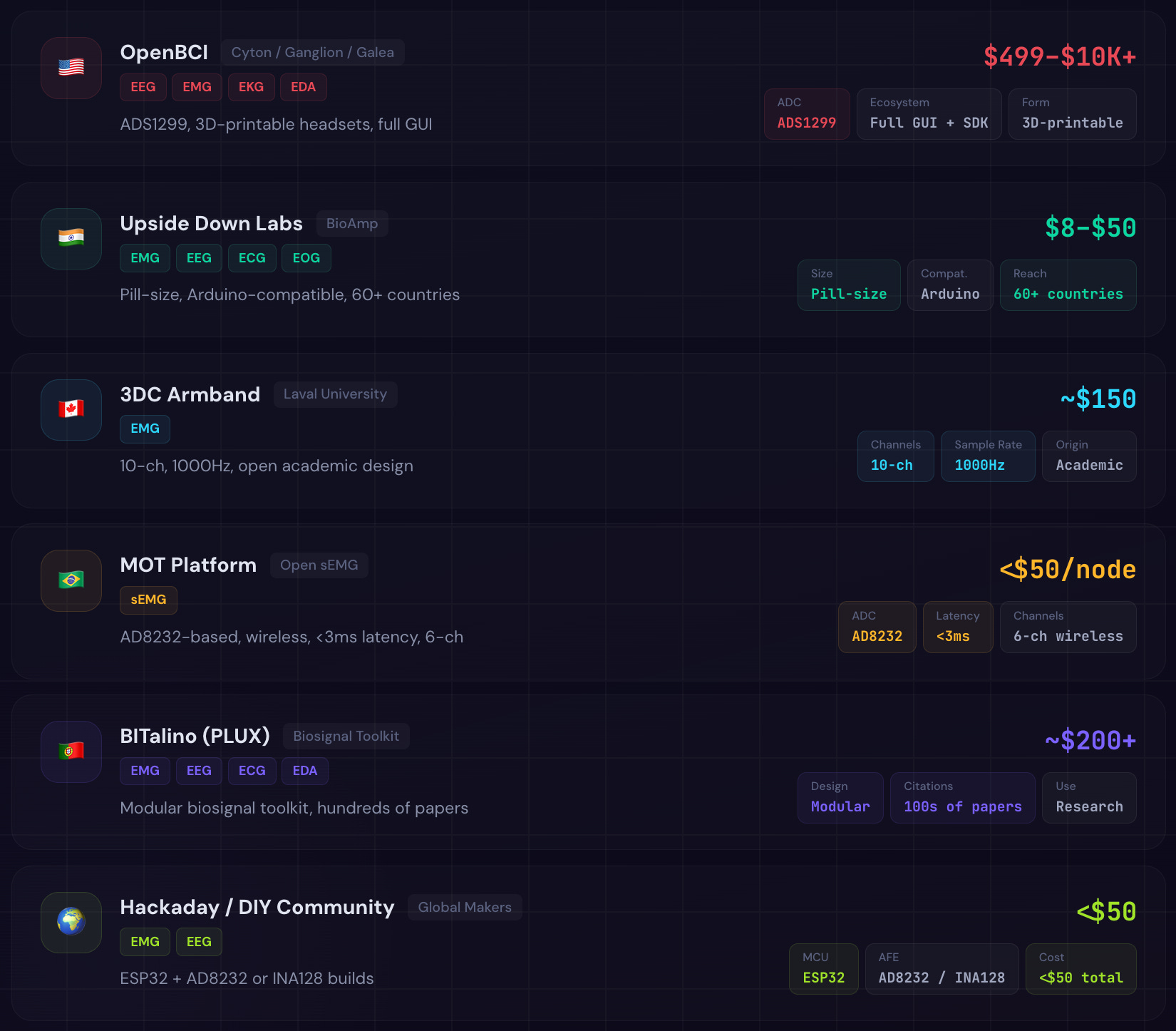
OpenBCI (Brooklyn, NY) – The “Arduino of brain-computer interfaces,” democratized neuroscience by making research-grade biosensing open-source. Funding: ~$2-4M. Products: Cyton (8-sensor board, ADS1299-based), Ganglion (4-sensor), Ultracortex Mark IV (3D-printable headset), Galea (enterprise multi-sensor headset), and OpenBCI GUI.
Research-Grade Platforms
Delsys (Natick, MA) – The gold standard in EMG instrumentation, used across 85+ countries. Funding: $12M+ in grants. Products: Trigno Avanti wireless EMG sensor, Trigno Centro base station, Trigno Research+ System, and Neuromap software.
BioSemi (Amsterdam, US distribution via Cortech Solutions) – Invented “active electrode” technology that revolutionized EEG. Self-funded since 1998. Products: ActiveTwo (8-256 sensor EEG with fiber-optic transmission), ActiveThree, and Active Electrode Sets MK3.
China (~20 BCI companies, massive state backing)
BCI / Invasive
NeuroXess (Shanghai) – Pioneered silk-protein-coated flexible brain electrodes, enabling a paralyzed patient to decode complex Mandarin sentences within 48 hours of implantation. Funding: ~$29.1M. Products: 256-Channel Flexible BCI Implant and Speech-decoding BCI System.
Beijing Xinzhida / NeuCyber (Beijing) – China’s flagship implantable BCI, on track for 50-patient clinical trial by 2026. State-backed. Products: Beinao No. 1 (the world’s first fully implanted wireless semi-invasive BCI chip) and Beinao No. 2 (next-gen chip demonstrated in monkey robot-arm control).
BrainCo (Hangzhou/Boston) – The largest-funded BCI company outside the US (~$286M raised). Products: FocusCalm ($280 EEG headband), OxyZen ($299+ meditation headband), Dexus Prosthetic Hand (AI-powered, CES 2020 Best Product), and NeuroMaker STEM kit.
Neural Galaxy (Beijing) – Co-founded by Harvard/MIT neuroscientists, invented “personalized Brain Functional Sectors” mapping. Funding: ~$100M. Products: pBFS (AI-driven brain mapping of 200+ functional networks) and POINT Therapy System (read-decode-write loop for treating 16+ brain conditions).
EMG
OYMotion Technologies (Xiamen) – Commercializing EMG gesture-control armbands at scale, pivoting into humanoid robotics. Funding: ~$14.4M. Products: gForce Pro+ (8-sensor medical-grade EMG armband), gForce 200 (consumer version), AI Bionic Prosthetic Hand, and 6-DOF Robotic Hand.
EEG
Shenzhen Amydi-med – Supply-chain enabler manufacturing EEG/EMG cables and sensors since 2009 with CFDA & CE certifications.
Multiple university-backed labs (Fudan’s $56M BCI research center, Tianjin University’s dedicated BCI degree program).
State Policy
Beijing, Shanghai, Guangdong, and Sichuan have all launched BCI development action plans (2025-2030) with targets like 3,000 invasive BCI surgeries annually by 2030 and nurturing 3-5 unicorn BCI companies.
India (emerging, open-source hub)
Nexstem (Bengaluru) – India’s most-funded BCI startup, building a full-stack “digital nervous system” platform. Funding: ~$6.2M. Products: Nexstem Instinct (19-sensor EEG headset with motorized self-adjusting electrodes and on-device AI) and Nexstem SDK.
Upside Down Labs (India) – A bootstrapped, fully open-source hardware company that democratized neuroscience experimentation, shipping 5,000+ DIY kits to 60+ countries. Bootstrapped (~$30K+ Crowd Supply, $100K+ revenue). Products include BioAmp EXG Pill (pill-sized sensor board under $10), Muscle BioAmp Shield, Muscle BioAmp Patchy, Muscle BioAmp Candy, Muscle BioAmp Blip, Chords software, and the upcoming Neuro Play Ground Lite.
Canada
Muse / InteraXon (Toronto) – Pioneered direct-to-consumer EEG with 200,000+ headbands sold, building the largest consumer neurofeedback dataset. Funding: ~$60M. Products: Muse 2 (meditation headband with real-time audio neurofeedback), Muse S Gen 2 (sleep tracking via actual brain signals), and Muse App.
Thalmic Labs / North (Kitchener-Waterloo) – Created the iconic Myo gesture-control armband, then pivoted to AR smart glasses. Funding: ~$192M. Acquired by Google (2020) for ~$180M. Products: Myo Armband (discontinued but still cited in hundreds of research papers) and Focals by North (cancelled).
3DC Armband (Laval University, Quebec) – Open-source academic project that outperformed the commercial Myo Armband in gesture recognition benchmarks, at ~$150 and fully 3D-printable. Products: 3DC Armband (10-sensor wireless EMG, 1000Hz sampling, 62g, all designs on GitHub).
Europe
Germany (~11 companies)
Brain Products GmbH (Gilching) – The gold standard in research-grade EEG hardware, profitable and self-funded (~$21M annual revenue). Products: actiCHamp Plus (modular amplifier), LiveAmp (wireless mobile EEG), actiCAP (active electrode caps), and BrainVision Recorder/Analyzer.
NIRx Medical Technologies (Berlin / New York) – World leader in fNIRS neuroimaging, recently merged with Artinis under Gilde Healthcare. Products: NIRScout (stationary fNIRS, 4-64 sources), NIRSport2 (portable 900g version), Aurora fNIRS, and Turbo-Satori real-time analysis.
G.tec Medical Engineering (Schiedlberg, Austria; DACH-wide) – The longest-running dedicated BCI company in the world (founded 1999). Funding: ~$2.2M in EU grants. Products: g.USBamp (16-sensor amplifier), g.Nautilus (wireless EEG), Unicorn Hybrid Black (consumer-friendly 8-sensor headset with Unity integration), and recoveriX (CE-certified stroke rehab system).
Netherlands
ANT Neuro (Hengelo) – University of Twente spin-off, part of The BrainCollective (~$16.6M annual revenue). Products: eego mylab (256-sensor high-density EEG), eego rt (BCI/neurofeedback device), eego sports (mobile sports EEG), and visor2 (FDA 510(k)-cleared TMS neuronavigation).
BioSemi (Amsterdam) – See US Research-Grade Platforms section. Invented “active electrode” technology, the de facto standard in cognitive neuroscience labs worldwide.
iMotions (Copenhagen, Danish; strong NL presence) – The Swiss Army knife of human behavior research, synchronizing EEG, eye tracking, skin conductance, facial expression, heart rate, and EMG. Funding: ~$5.2M. Products: iMotions Lab and iMotions Online.
Spain
Neuroelectrics (Barcelona / Boston) – Combined wireless EEG monitoring + brain stimulation in a single device. Funding: ~$17.9M. Products: Enobio (wireless EEG headcap), Starstim (hybrid EEG + stimulation device, CE-marked), Starstim Home (at-home version), and NIC cloud software.
Bitbrain (Zaragoza) – A rare full-stack neurotechnology company spanning dry EEG hardware to AI-powered cognitive state estimation. Products: Diadem (12-sensor portable dry EEG), Hero (9-sensor motor-imagery BCI), Ring (skin conductance wearable), Usenns (neuromarketing), and Elevvo (neurostimulation).
France ($193M in BCI funding)
NextMind (Paris, acquired by Snap in March 2022) – Users control interfaces by looking at visual “tags” and focusing attention. Funding: ~$4.6M + acquired by Snap (~$13M est.). Products: NextMind Dev Kit (discontinued, open-sourced) and NextMind SDK with Unity integration. Team integrated into Snap’s AR Spectacles division.
Strong academic pipeline (INRIA, CEA).
Switzerland ($267M in funding)
MindMaze (Lausanne) – The largest neurotech unicorn in Europe (valued at $1.5B), combining neuroscience, VR, and motion capture for stroke rehabilitation. Funding: ~$224M+. Products: MindMotion PRO (bedside stroke recovery), MindMotion GO (mobile neurotherapy), Izar (hand dexterity rehab device), and MindPod Dolphin.
IDUN Technologies (Zurich) – ETH Zurich spin-off capturing research-grade EEG from inside the ear canal. Funding: ~$3.9M. Products: IDUN Guardian 4 (brain-sensing earbuds), IDUN Guardian SDK, and a CES 2025 reference design with Analog Devices.
Portugal
BITalino / PLUX (Lisbon) – Created the “Arduino of biosignals” for under $200. Funding: ~EUR 3M in EU grants. Products: BITalino (r)evolution (~$200 modular biosignal board), biosignalsplux (professional-grade wireless), PhysioPlux (biofeedback for physiotherapy), and OpenSignals software.
Academic EMG research – Mahmoud Tavakoli et al. developed a minimalist 2-sensor EMG band achieving 4-gesture recognition at 1000 Hz.
United Kingdom (~12 companies)
BIOS Health (Cambridge) – Building the “neural genome project” using AI to decode neural signals for precision bioelectronic medicines. Funding: ~$26M. Products: BIOS Neural Dosing Platform (deployed across 8 global clinical sites) and preclinical neural interface suite.
Hird (UK) – In-ear EEG earbuds for enterprise HR and wellbeing. Products: Hird Neurotech Earbuds, Hird App, and Hird Manager Dashboard.
Strong academic hubs at Imperial, UCL, Oxford.
Australia
Emotiv (founded Sydney, HQ SF) – See US section for full details.
Compumedics (Melbourne, ASX: CMP) – The only publicly listed pure-play neurodiagnostics company in Australia. ASX-listed (AU$50.3M revenue FY2024). Products: CURRY 9 Neuroimaging Suite (combines EEG, MEG, MRI, CT), Grael HD (world’s first HD EEG/sleep amplifier), Somfit (forehead sleep tracker using actual EEG, pursuing FDA clearance), and Profusion EEG Software.
Israel
Neurosteer – Distills clinical EEG into a single adhesive forehead strip. Funding: ~$8.6M. FDA-cleared since November 2022. Products: Neurosteer EEG Platform (disposable adhesive electrode strip for up to 12 hours continuous monitoring), Brain Metrics cloud AI, and Cognitive Assessment Tool for early Alzheimer’s/Parkinson’s screening.
Strong defense-tech to neurotech pipeline.
Japan
Nihon Kohden (Tokyo, TSE: 6849) – The world’s largest supplier of EEG systems, 73-year legacy. Market cap ~$1.9B (~$1.48B annual revenue). Products: Neurofax EEG-1200 (flagship clinical platform), Neurofax EEG-9100 (portable version), NeuroWorkbench, and Ad-Tech Electrodes (stereo-EEG depth electrodes, acquired 2024).
Osaka University BCI research for disease diagnosis.
Brazil
MOT Platform (Federal University of Technology, Curitiba) – Fully open-source wireless EMG system from commodity components (under $50 per sensor node). Products: MOT Sensor Nodes (six 22g wireless sensors, AD8232-based, 1000Hz sampling), MOT Central Receiver (ESP-NOW protocol, <3ms latency, <0.5% data loss at 100m range), and MOT Software.
Miotec (Porto Alegre) – Brazil’s homegrown champion in clinical EMG, 20+ year ecosystem for pelvic floor physiotherapy across Latin America. Products: New Miotool (wireless 2/4/8-sensor EMG, 16-bit, 2000 samples/sec), MiotecSuite (biofeedback therapy software), and Mioflux (healthcare workflow platform).
Russia
Neurosoft (Ivanovo) – The only Russian manufacturer of magnetic stimulators and first to produce an integrated EEG+TMS system, selling to 102 countries. 2024 EEG revenue ~$70M. Products: Neuron-Spectrum Series (digital EEG, up to 64 sensors), Neuro-MEP Series (EMG/nerve conduction), TMS Systems (Russia’s only domestic TMS, including world-first integrated TMS-EEG), and Neuro-IOM (intraoperative monitoring).
Silent Speech Interfaces
A new category of neural interface that reads subvocalized speech – words you “say” in your head without making a sound. These devices intercept the signals your brain sends to your speech muscles (jaw, tongue, throat, face) before any audible sound is produced.
AlterEgo (MIT Media Lab -> Startup, Cambridge MA) – The device that made “telepathy” real. Founded by Arnav Kapur (CEO) and Max Newlon (COO, ex-US president of BrainCo). Won the $15,000 Lemelson-MIT Student Prize. Products: AlterEgo Wearable, a sleek device worn around the ear and jawline with seven electrodes that detect neuromuscular signals during internal articulation. Achieves 92% median word accuracy and recognizes 100+ words per minute. Consumer version launched September 2025.
Apple / Q.ai (Cupertino / Israel) – Apple’s second-largest acquisition ever (~$1.5-2B, January 2026). Q.ai uses tiny cameras to detect facial skin micro-movements during silent speech, suggesting Apple is building silent Siri for future AirPods or AR glasses. Q.ai CEO Aviad Maizels previously founded PrimeSense (acquired by Apple in 2013 for Face ID). ~100 employees integrated into Apple’s hardware division.
xTrodes (Herzliya, Israel) – Ultra-thin, flexible adhesive electrode patches that stick to facial and neck skin like temporary tattoos. Funding: ~$5.5M + EUR 5.2M EIC grant. FDA-validated for sleep disorder diagnosis. The same technology could translate silent speech into text.
Ear-EEG: Big Tech’s Next Frontier
All three major consumer earbud manufacturers – Apple, Samsung, and Google – have patents, prototypes, or shipping products that add brain-sensing (EEG) to earbuds.
Apple (Cupertino) – Filed patents for EEG-sensing AirPods with dynamic electrode selection (US20230225659A1, July 2023). Current AirPods Pro 2 already include PPG heart rate, clinical-grade hearing test (FDA authorized), and hearing aid mode. EEG would be the next biosensing layer. Patent describes multiple active and reference EEG electrodes with AI-driven dynamic selection. Combined with Q.ai acquisition, the direction is clear. Estimated launch: ~2027-2029.
Samsung (South Korea) – Galaxy Buds-style “Ear-EEG” prototype with Hanyang University. 47 patents filed. Published in IEEE Sensors Journal. Demonstrated drowsiness detection and video preference identification (92.86% accuracy from brainwaves alone). Patent portfolio covers electrode geometry, artifact removal, and privacy-preserving on-device inference. Estimated launch: ~2027.
NextSense (Google X spinoff, San Francisco) – Shipping the world’s first truly wireless earbuds with clinical-grade EEG. Funding: $16M Series A (November 2025). Products: NextSense Smartbuds ($399, shipping February 2026) with 6 built-in EEG sensors for adaptive sleep enhancement. Validated against hospital EEG in 1,255+ hours of recording from 20 epilepsy patients, detecting 86.4% of seizures.
IDUN Technologies (Zurich) – See Switzerland section. ETH Zurich spin-off with patented DRYODE in-ear dry electrodes.
Hird (UK) – See UK section. In-ear EEG earbuds for workplace cognitive monitoring.
The Convergence Timeline
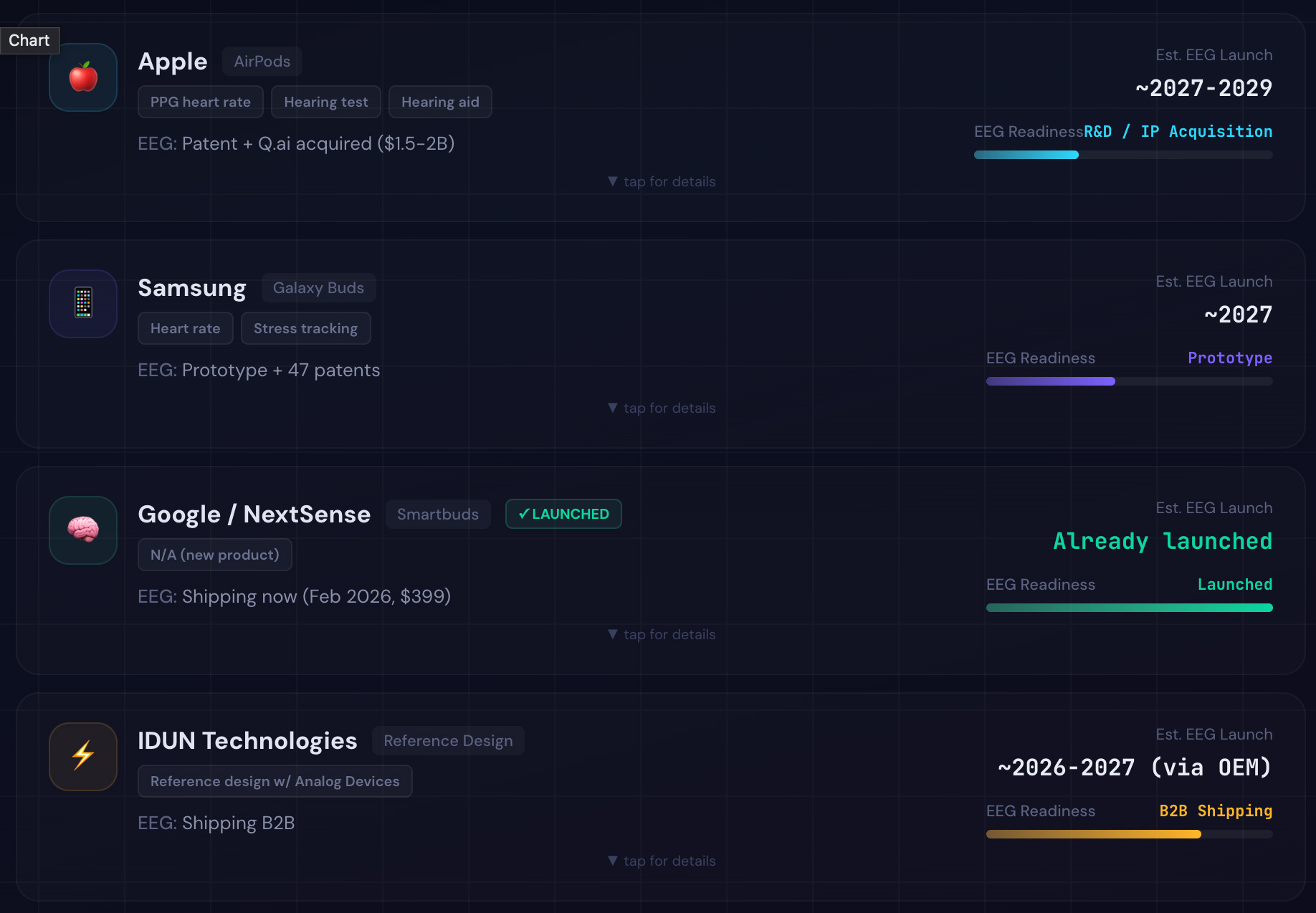
The pattern is clear: health sensing in earbuds started with heart rate (PPG), expanded to hearing health, and is now converging on brain activity (EEG). When Apple adds EEG to AirPods (likely within 3-5 years), it will instantly create the largest brain-sensing installed base in history.
Open-Source & DIY Ecosystem Summary
Mentioned startups / companies in this article:
Neuralink, Synchron, BrainCo, Blackrock Neurotech, MindMaze, Precision Neuroscience, Kernel, Paradromics, Neural Galaxy, Neurable, Emotiv, NeuroSky, Advanced Brain Monitoring, Wearable Sensing, Narbis, Pison, Myomo, OpenBCI, Axoft, NeuroXess, NeuCyber/Beijing Xinzhida, OYMotion Technologies, Nexstem, Upside Down Labs, Muse/InteraXon, Thalmic Labs/North, 3DC Armband, Brain Products, NIRx Medical Technologies, G.tec Medical Engineering, ANT Neuro, BioSemi, iMotions, Neuroelectrics, Bitbrain, NextMind, MindMaze, IDUN Technologies, BITalino/PLUX, BIOS Health, Hird, Compumedics, Neurosteer, Miotec, Neurosoft, AlterEgo, Q.ai, xTrodes, NextSense, Delsys, and Shenzhen Amydi-med.
First published on Substack on Feb 27, 2026. This is the canonical copy.