What Comes After the Attention Apocalypse
pump fun broke crypto
pump fun broke crypto
not because it failed. because it worked too well. over 11 million tokens launched since January 2024. a graduation rate that’s dropped below 1%. nearly $800 million in lifetime revenue extracted from a system designed to churn.
this isn’t a bug. it’s the logical endpoint of permissionless creation without permissionless evaluation.
The Tragedy of Infinite Tokens
here’s the brutal math: roughly 100 tokens graduate daily across all platforms now, down from the highs. at peak mania in November 2024, the platform hit 45,465 launches in a single day—31.5 new tokens per minute. the range has swung wildly, from 4,500 to over 70,000 on single days.
the average lifespan of a memecoin on pump is just 12 days. every day, roughly 10,000 new tokens are created, but almost as many die within the same period—a near 95% turnover rate.
of 968,819 tokens examined over a three-month period, a staggering 98% had already died. only 2% were still alive.
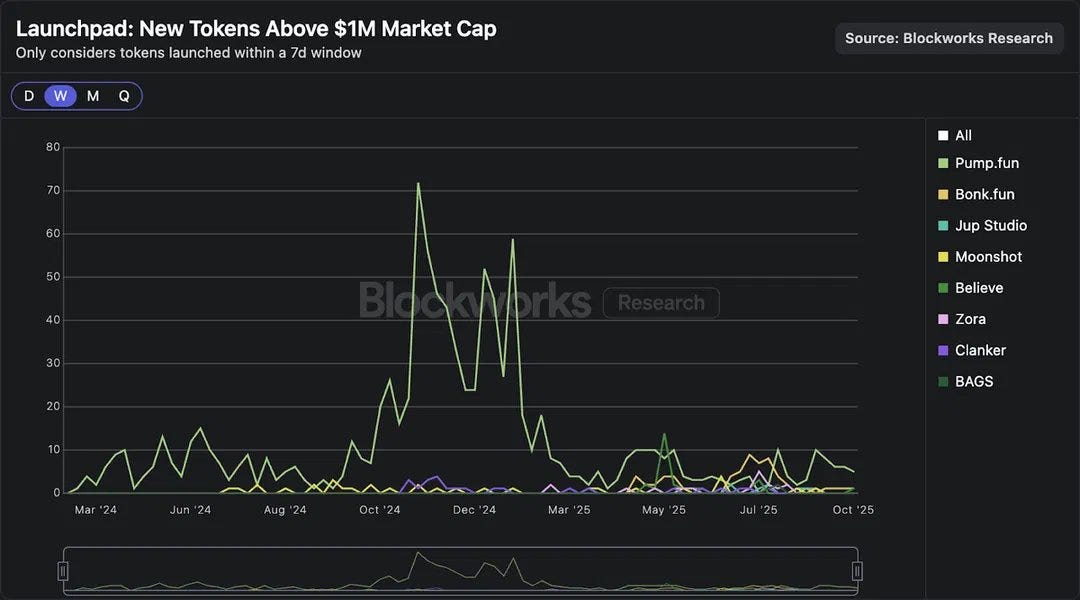
The Casino Incentive
here’s the thing nobody talks about: pump doesn’t want runners.
think about it. they take 1% on every trade (even more now lol). every new token launch is a fresh extraction opportunity. every failed graduation means traders rotating into the next thing, generating more fees. the platform is architecturally optimized for churn, not for producing the next Dogecoin.
@MustStopMurad talked about this. the reason we don’t see massive memecoin runners anymore isn’t lack of demand. it’s attention fragmentation. when Dogecoin emerged, there wasn’t an infinite stream of competitors. attention could concentrate. capital could compound. a community could form around a single Schelling point and ride it to $80 billion.
now? attention gets split across thousands of daily launches. capital gets diluted across endless positions. no single token accumulates enough escape velocity to break out. the platform still generates roughly $1 million in daily revenue while users chase increasingly diminishing returns.
this is the casino model. the house doesn’t want you to hit the jackpot and leave. the house wants you playing forever, bleeding chips on every spin. pump has generated nearly $800 million in revenue not by producing winners, but by producing an endless stream of games to play.
capital efficiency: zero. signal extraction: impossible. incentive alignment: adversarial.
The Quantum Fix
@Paradigm dropped a new mechanism - an “upgrade” of futarchy - called Quantum Markets. the core insight is deceptively simple: what if the same capital could evaluate unlimited proposals simultaneously?
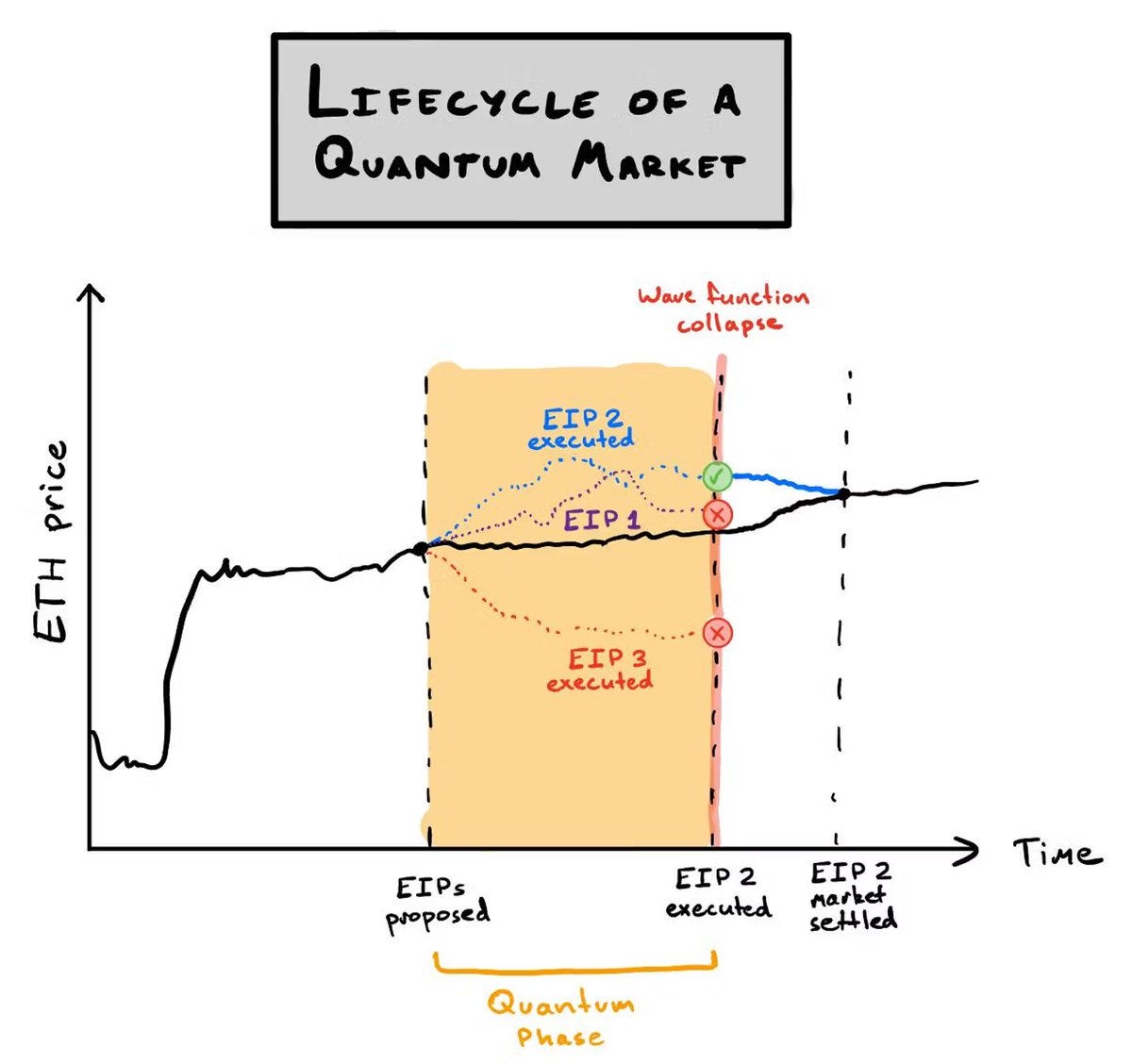
here’s how it works. trader deposits funds once. gets equivalent trading credits across all current and future proposals within a decision. trades freely on each proposal’s expected outcome. when settlement hits, only the winning proposal (highest predicted value) actually resolves. every other market reverts. traders who didn’t touch the winner just get their principal back.
wave function collapse, but for capital markets.
for token launchpads, this inverts everything. instead of thousands of tokens fighting over a fixed liquidity pool daily, you could evaluate *millions* of proposals using the same capital base. the trader with $100k doesn’t spread it thin across positions. they deploy the full $100k on every single proposal that matters to them.
The New Launchpad
picture a quantum-native pump. one token launches per hour. anyone can propose infinite tokens for each slot. every proposal becomes instantly tradable. traders express predictions about which token will achieve highest market cap.
the $100k trader takes real positions across all proposals. bullish on one concept, bearish on obvious scams, neutral on the noise. same capital, working simultaneously across every option.
hour ends. market observes predicted values. selects the single highest-expected token. that one launches. everything else vanishes. but if you didn’t bet against the winner, you keep your principal. no capital lost to failed experiments unless you actively chose wrong.
this kills sniping. speed stops mattering when capital can be deployed thoughtfully across all options. what matters is *relative* quality assessment. can you identify which proposal outperforms the rest?
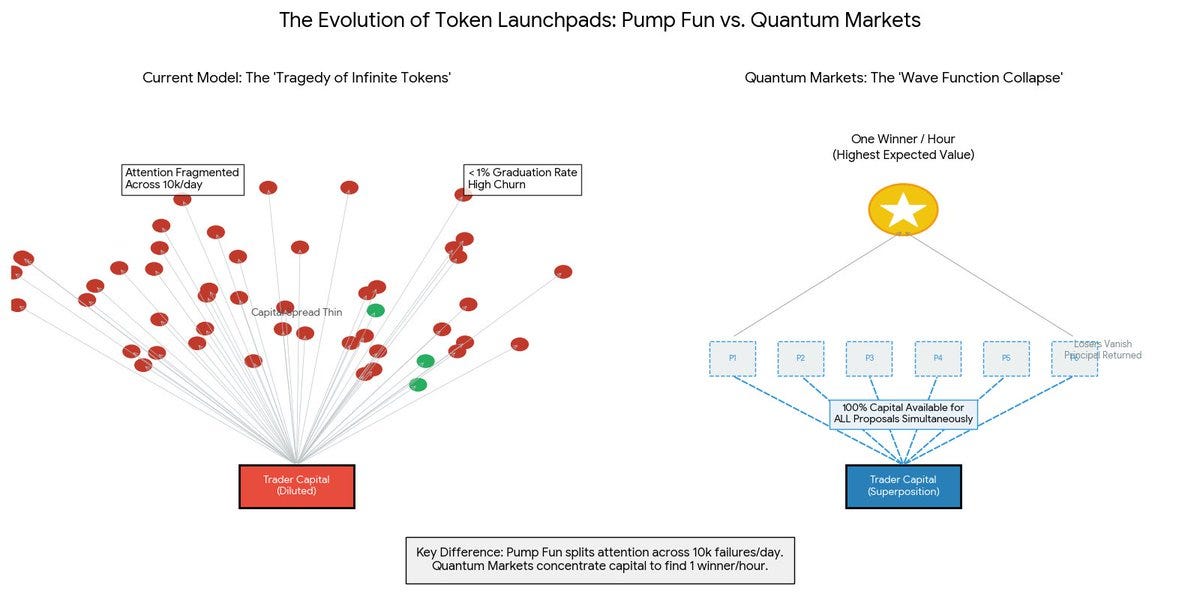
but more importantly: attention concentrates. instead of fragmenting across thousands of simultaneous launches, the mechanism forces convergence on a single winner per time slot. capital compounds instead of dilutes. communities can actually form around tokens that earned their spot through competitive evaluation, not just who screamed loudest in the first 30 seconds.
this is how you get runners again. not by restricting supply artificially, but by creating a mechanism where quality naturally surfaces and attention naturally concentrates.
From Lottery to Laboratory
pump proved permissionless token creation has massive demand. it also proved (accidentally) that permissionless creation without efficient evaluation leads to tragedy of the commons. infinite tokens. finite attention. almost everything fails. and the platform profits regardless.
quantum markets offer the escape: a mechanism where the same capital drowning in today’s token flood could instead evaluate millions of proposals and surface only what’s worth launching.
not a lottery. a laboratory.
not a casino optimized for churn. a coordination mechanism optimized for emergence.
the attention apocalypse already happened. the question is what we build on the ashes?
First published on Substack on Jan 6, 2026. This is the canonical copy.